Top Emergency Work Light Manufacturers in China

China’s lighting industry serves a wide range of buyers, from repair crews and vehicle technicians to emergency-response teams. This guide introduces leading Emergency Work Light manufacturers in China and the factors that can help buyers compare them. A useful supplier review goes beyond catalog photos. It looks at beam shape, brightness controls, battery capacity, charging options, grip comfort, and heat management during extended use.

Small details matter. A lamp that tips over on a wet workshop floor may be less useful than its headline brightness suggests. For this reason, the overview considers product range, manufacturing capability, customization options, quality-control practices, and communication with overseas customers. It also notes where public information may be limited, since supplier claims should be checked against current product documents and sample testing. That step is easy to overlook.

The right choice depends on the job. A magnetic base can help during vehicle repairs, while a compact, impact-resistant body may suit cramped service spaces. Buyers should compare runtime under realistic brightness settings, not just the best-case figure on a product sheet. No single factory fits every need. The manufacturers covered here offer different strengths, and product specifications can change over time. Treat this overview as a starting point, then confirm details directly with each supplier before making a purchasing decision.
Top Emergency Work Light Manufacturers in China

What Defines an Emergency Work Light and Its Main Applications?

An emergency work light is a portable light designed to illuminate hands-on tasks when normal lighting fails or a worksite has no reliable power. It may use a rechargeable battery, replaceable cells, or a vehicle power source. Unlike an exit sign or fixed emergency luminaire, it is meant to help people see tools, equipment, and nearby hazards. It does not automatically meet requirements for exit-route lighting; OSHA’s 29 CFR 1910.37 separately requires exit routes to be adequately lighted.

Its main applications include equipment repair during outages, vehicle maintenance, construction, utility work, and inspections in dim warehouses or remote locations. A magnetic base can hold a lamp against a steel panel, while a hook or adjustable stand keeps both hands free. Useful selection details include beam spread, runtime at the chosen brightness, charging time, and resistance to dust or water. Small details matter.

The U.S. Department of Energy’s Energy Saver guidance says LEDs use at least 75% less energy and can last up to 25 times longer than incandescent bulbs. That comparison supports LED efficiency, but it does not guarantee a portable lamp’s runtime or durability. Check measured operating time and battery specifications. A bright rating alone can mislead; on a real repair, sustained, even light may matter more than a brief high-output beam.

How China’s Emergency Work Light Manufacturing Industry Is Structured

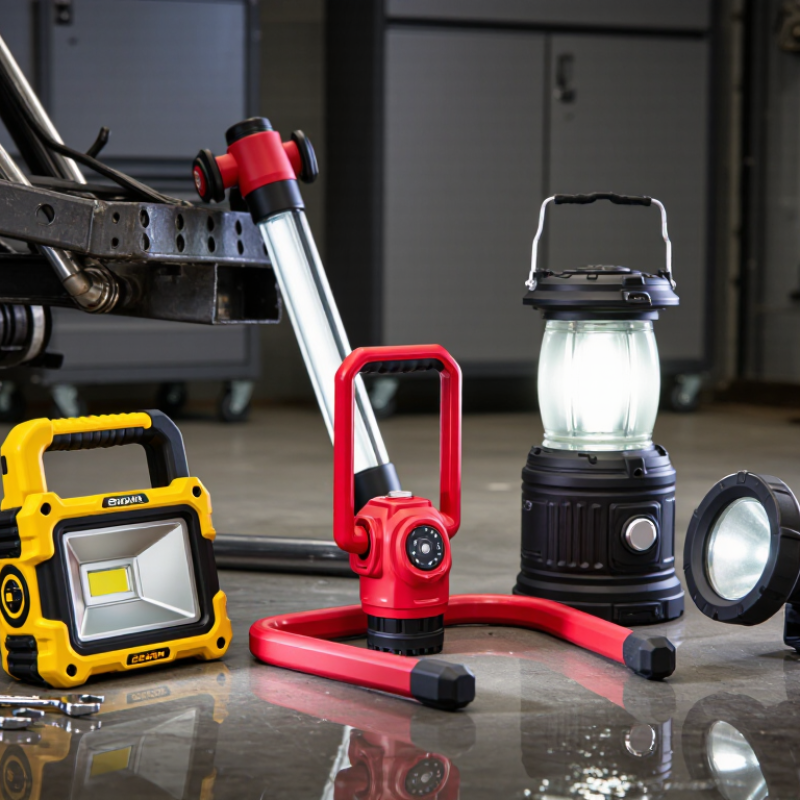
China’s emergency work-light industry is structured around specialist component suppliers, product designers, and assembly manufacturers. Upstream firms provide LED modules, optical lenses, rechargeable cells, switches, charging circuits, and molded housings. Assemblers combine these parts into inspection lamps, magnetic under-hood lights, and tripod floodlights. A small design choice matters: a lens can create a focused beam, while a frosted cover spreads light across a repair bench.

The International Energy Agency’s Global EV Outlook 2024 reports that China produced nearly 80% of the world’s battery cells in 2023. That figure describes the broader battery industry, not emergency work lights alone. Still, it helps explain why manufacturers can source battery expertise and related components locally. The link is useful, but imperfect. Work-light makers must also manage heat, impact resistance, grip, charging time, and consistent output. A sealed switch may look simple; testing it after dust exposure is less simple. Many suppliers operate as OEM or ODM partners, so buyers often compare specifications, sample quality, and production controls rather than factory labels. In this fragmented structure, one weak connector can undermine an otherwise solid lamp.

Top Emergency Work Light Manufacturers in China

How China’s Emergency Work Light Manufacturing Industry Is Structured

Emergency work light production commonly spans component sourcing, LED and circuit-board assembly, optical and housing assembly, battery integration, product testing, and OEM/ODM packing for distribution. The chart shows the typical sequence of these production stages; the numbered values indicate order only, not market share, company counts, or production volumes.

Leading Emergency Work Light Manufacturers in China

Leading Emergency Work Light Manufacturers in China support construction, vehicle repair, utilities, and other demanding work sites. Strong manufacturers connect product design with practical testing, not just bright output. Buyers should compare beam patterns, runtime, charging options, impact resistance, and protection from dust or water. Ask how performance is checked across production batches. A clear answer matters.

Tips: Request test data for the exact model, not a similar product. Check whether the light stays stable on uneven floors and whether switches work with gloves. Small details matter.

Reliable suppliers explain limitations as well as features. Battery runtime can change with brightness, temperature, and battery age, so a single headline figure may not tell the whole story. Review sample units under realistic conditions, such as a dim workshop or a roadside repair area.

Check heat around the handle after extended use, and inspect cable ports, hinges, and mounting points. A specification sheet can still miss these details. Not always obvious.

Compare communication, customization capability, quality checks, and after-sales support alongside price. A lower quote may leave important questions unanswered.

How to Compare Chinese Emergency Work Light Suppliers

When comparing Chinese emergency work light suppliers, request identical test evidence for every model, not polished catalog claims. Ask for measured lumen output, runtime at full brightness, charging time, battery type, and beam distribution. A lamp that looks bright against a factory wall may dim after an hour. Test samples on a bench and in a wet, dusty work area. Small details matter.

The U.S. Department of Energy’s lighting guidance says LEDs use at least 75% less energy and can last up to 25 times longer than incandescent bulbs. Treat this as a technology benchmark, not proof of a work light’s runtime. Request independent photometric reports using IES LM-79 methods where applicable, along with ingress-protection test records, temperature limits, and battery-cycle data. Confirm that documents cover the exact model and production configuration. A similar model number is weak evidence. Ask about incoming inspection, aging tests, warranty exclusions, and replacement-part availability. Compare these alongside unit price. I would order a pilot batch before a large purchase; it takes time. No spreadsheet fully predicts field handling. Real use can reveal loose hinges, glare, or charging ports that paperwork misses.

Key Trends Shaping China’s Emergency Work Light Market

China’s emergency work-light market is moving beyond simple brightness. Buyers increasingly compare runtime, charging speed, beam control, and durability. On a repair site, a light must survive dusty floors, gloved hands, and sudden power loss. Compact magnetic bases and adjustable stands are practical features, not decoration.

Battery performance is becoming a key differentiator. Rechargeable designs reduce disposable-battery use, while USB-C charging can simplify field logistics. Yet runtime claims are hard to compare when tests use different brightness settings. This remains a weak spot. China’s National Bureau of Statistics reported that industrial value added rose 5.8% in 2024, with high-tech manufacturing up 8.9%. That signals strong manufacturing activity, but does not directly measure work-light sales.

Energy resilience also shapes product development. The IEA’s Global Energy Review 2025 reported that global electricity demand grew 4.3% in 2024. For Chinese manufacturers, this is a broad infrastructure signal, not proof of market growth. Buyers may favor efficient LEDs, replaceable batteries, and clear low-charge warnings. Small details matter. A bright lamp is less useful if its switch is hard to find in rain or darkness. Manufacturers should publish tested runtime and charging data, even when the figures look less impressive.