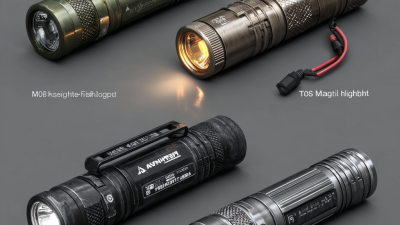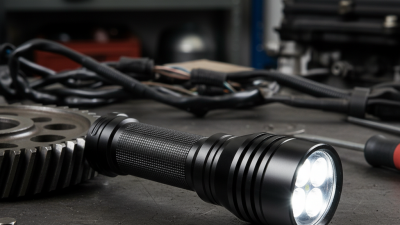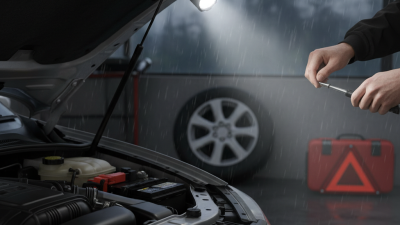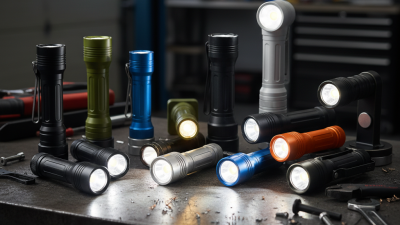
A Magnetic Flashlight is no longer a simple emergency tool. It is now used on steel shelving, vehicle hoods, workshop beams, and narrow service spaces. Buyers compare brightness, battery life, charging methods, magnet strength, water resistance, and international compliance. A high lumen number can still disappoint.
Market research supports this growing attention. Grand View Research identifies rising LED adoption, longer product life, and wider outdoor use as key flashlight market drivers. The U.S. Department of Energy also reports that LED lighting uses at least 75% less energy than traditional incandescent lighting. That advantage matters when a Magnetic Flashlight must run through long inspections or overnight repairs. However, market estimates differ between research firms. Treat forecasts as direction, not certainty.
Anthony Maglica, founder of Mag Instrument, has long been associated with the product promise, “Built to last a lifetime.” That principle remains useful, but durability needs evidence. Look for tested drop resistance, sealed charging ports, stable output, and clear battery specifications. ANSI/NEMA FL 1 performance standards can help buyers compare beam distance, impact resistance, runtime, and water resistance. Yet labels may not reveal every weakness. A magnet can hold firmly on clean steel, then slide across painted or vibrating surfaces. Small details matter.
This guide presents seven practical Magnetic Flashlight buying tips for global buyers. It considers workplace habits, shipping realities, plug compatibility, warranty support, and regional safety expectations. Some recommendations will not fit every user. That is the point. The best purchase depends on the surface, climate, task, and hands using it.
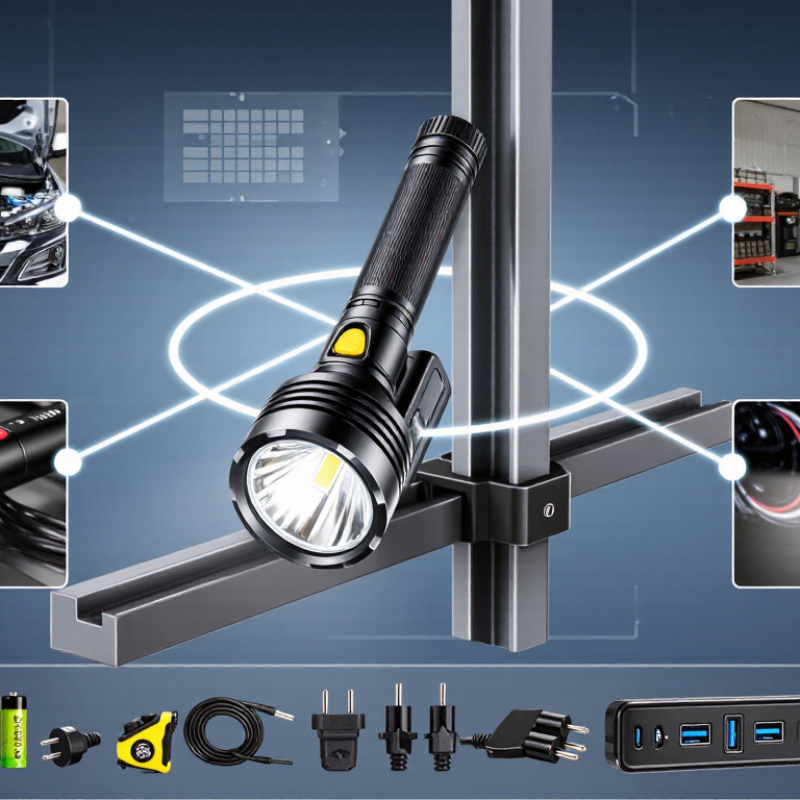
7 Magnetic Flashlight Buying Tips for Global Buyers
Define the job before comparing brightness. A magnetic flashlight for vehicle inspection needs stable hands-free lighting and a focused beam. A warehouse user may need wider coverage and longer runtime. Check the magnet’s holding strength on painted steel, not only bare metal. Tip: Test it at the angle you will actually use. A strong magnet can still slide on dusty or curved surfaces.
ANSI/PLATO FL 1 ratings make product claims easier to compare. Look for tested values covering beam distance, peak beam intensity, runtime, impact resistance, and water resistance. Runtime deserves careful attention. Some measurements end when light output drops significantly, not when the lamp becomes completely dark. I once chose a flashlight by its maximum lumens alone. That was a mistake. The beam looked impressive, but its useful runtime was too short for inspection work.
Tip: Ask for clear rating symbols, test conditions, and operating modes. A high beam-distance figure may not suit close-range repairs, where a broad beam is more practical. Impact resistance can indicate durability, but it does not guarantee waterproof performance. Check the separate water-resistance rating and understand its limits. Global buyers should also confirm charging requirements, battery specifications, and instructions in a suitable language. Small details matter. A flashlight can meet a recognized performance standard and still feel poorly matched to the job.
The chart shows buyer-planning beam-distance benchmarks calculated from peak beam intensity using the ANSI/PLATO FL 1 relationship: Beam Distance = √(Peak Beam Intensity ÷ 0.25). These are use-case benchmarks, not certification limits or brand specifications.
Global buyers should compare flashlight measurements under the same test method. ANSI/PLATO FL 1-2019 defines useful terms, including lumens, candela, beam distance, and runtime. Lumens measure total light output, while candela measures peak intensity. A 1,000-lumen flashlight may illuminate a wide campsite, but a lower-lumen model can throw farther with a tighter beam. Look for both figures.
Beam distance is calculated to the point receiving 0.25 lux, according to the ANSI/PLATO method. This figure is useful, but it can feel optimistic outdoors. Check the candela value for a clearer long-range comparison. The U.S. Department of Energy’s 2023 Solid-State Lighting R&D Plan reports laboratory LED efficacy above 200 lumens per watt. Complete flashlights perform lower because optics, drivers, batteries, and heat reduce efficiency. Marketing numbers rarely show that loss.
Runtime needs closer attention. ANSI/PLATO FL 1 testing measures operation until output falls to 10% of its initial level. A listed 20-hour runtime may therefore include many dim hours. Study runtime graphs, not only the headline number. I once chose by lumens alone. That was a mistake. For field work, compare sustained output, battery capacity, charging time, and thermal regulation. A useful buying sheet records lumens, candela, beam distance, and runtime at the same temperature. Small differences matter. A cold battery can also distort real-world results.
When choosing a magnetic flashlight, inspect the battery chemistry before comparing brightness. Lithium-ion cells usually provide strong output and compact size. However, they require protection against overcharging, deep discharge, and excessive heat. Nickel-metal hydride cells are less energy-dense, but they can suit buyers who prefer removable rechargeable batteries. Ask for the rated capacity, operating temperature, and replacement-cell guidance. A printed capacity alone proves little. I once trusted an impressive number and found the runtime disappointing in cold weather.
USB-C charging adds convenience, but connector design matters. Check whether the port supports charging only or also power output. A sealed rubber cover should close firmly after charging. Loose covers can admit dust and moisture during workshop use. Confirm the input voltage range for local charging equipment. Some lights include basic cables, yet not a suitable wall adapter. That small omission affects actual usability.
A claimed 500+ cycle life needs careful interpretation. It may describe battery capacity remaining after laboratory testing, not every part of the flashlight. Ask whether cycles were tested at full discharge, moderate discharge, or controlled temperatures. Heat, frequent high-output use, and poor charging habits can shorten service life. Magnetic strength also deserves a practical check. The light should hold on a painted steel cabinet without sliding when warmed. Test it at several angles. Magnets can weaken from impact, and manufacturers do not always publish pull-force data.
| No. | Buying Tip | Recommended Specification | Relevant Data | Why It Matters for Global Buyers | Verification Checklist |
|---|---|---|---|---|---|
| 1 | Assess battery chemistry | Choose a protected lithium-ion pack for a compact rechargeable design, or LiFePO4 where long cycle life and thermal stability have priority. | Typical nominal voltage: Li-ion 3.6–3.7 V; LiFePO4 3.2 V; NiMH 1.2 V per cell. | Chemistry affects energy density, weight, charging requirements, service life, and transport documentation. | Request the chemistry, cell configuration, protection-circuit details, rated capacity, and safety test documentation. |
| 2 | Verify 500+ cycle life | Target a battery pack rated for at least 500 complete charge-discharge cycles while retaining approximately 80% of its original capacity. | One cycle means cumulative discharge equal to 100% of rated capacity; partial discharges add together. | A cycle rating is more meaningful than a simple warranty claim, but actual life also depends on heat, charging speed, depth of discharge, and storage. | Check the test temperature, cutoff voltage, charge rate, discharge rate, end-of-life capacity, and whether the rating applies to the cell or complete pack. |
| 3 | Examine USB-C charging | Prefer a USB-C input that clearly states 5 V charging parameters and includes overcharge, overcurrent, short-circuit, and thermal protection. | Standard USB power commonly uses 5 V; USB Power Delivery can negotiate higher voltages only when both source and device support the required profile. | Clear input specifications improve compatibility with chargers, power banks, and travel adapters used in different markets. | Confirm connector type, input voltage/current, charging time, cable requirements, indicator behavior, and whether charging is allowed while operating. |
| 4 | Compare real runtime, not only lumens | Require runtime figures for multiple brightness levels and ask for test conditions based on a recognized flashlight performance method. | Approximate battery energy can be estimated as voltage × ampere-hours; for example, 3.7 V × 2.0 Ah ≈ 7.4 Wh before conversion losses. | Advertised peak lumens may last only briefly, while working modes determine practical use and battery consumption. | Request initial output, sustained output, runtime, step-down behavior, operating temperature, and the battery capacity used in the test. |
| 5 | Check magnetic mounting strength | Select a magnet and mounting surface suitable for the intended load, vibration level, and angle; a swivel or rotating head improves positioning. | Magnetic holding force varies with magnet grade, contact area, steel thickness, air gap, surface condition, and pull direction. | A magnet may hold well in a direct pull but support much less weight on a vertical or vibrating surface. | Ask for measured pull force, test surface and direction, anti-slip material, magnet corrosion protection, and hinge load limits. |
| 6 | Confirm environmental protection | Choose an IP rating that matches the application; IP65 protects against dust and water jets, while IP67 also covers temporary immersion under defined test conditions. | The first IP digit indicates solid-particle protection; the second indicates water protection. IP ratings do not automatically indicate impact resistance. | Weather, dust, and temperature conditions differ by region, workplace, and shipping environment. | Verify the exact IP test report, sealing design, operating temperature range, impact rating, and whether the USB-C port is sealed during use. |
| 7 | Review international compliance and logistics | Request applicable electrical safety, electromagnetic compatibility, battery transport, and recycling documentation for the destination market. | Lithium batteries are commonly subject to transport rules covering watt-hours, packaging, labeling, documentation, and test summaries. | Correct documentation reduces customs delays, air-freight restrictions, compliance risk, and disposal problems. | Confirm battery watt-hours, UN 38.3 test summary, safety data, user manual language, warranty terms, plug or charger configuration, and recycling obligations. |
Note: Actual performance varies with battery quality, circuit design, temperature, charging conditions, and test methods. Request product-specific test reports before placing a bulk order.
A magnetic flashlight should be judged by its real pull strength, not a large number on a product page. Ask whether the rating applies to clean, thick steel. Thin panels, paint, dust, and curved surfaces reduce contact. A flashlight weighing 300 grams may need much more holding force during vibration. Test it on a vertical steel surface with fresh batteries installed. Then check for slipping after several minutes.
Magnet material also affects service life. Neodymium magnets offer strong pull in a compact size, while ferrite magnets usually provide lower force but better cost stability. The magnet should have a protective coating or sealed housing. Exposed metal can corrode near rain, salt air, or workshop chemicals. Request material details, temperature limits, and repeatable laboratory test data. Vague claims are not enough. They often hide useful limitations.
Mounting safety deserves equal attention. A rubberized base can improve grip and protect painted surfaces, but it cannot replace proper mechanical retention. Look for a secure magnet cup, solid threads, and a backup lanyard attachment. I once trusted a strong magnet on a dusty beam; the flashlight fell after a small vibration. That mistake changed my inspection routine. Check the surface, clean the contact area, and test the mount under the actual angle of use. A cautious buyer should also examine battery weight, impact resistance, and the manufacturer’s written load guidance before ordering across borders.
Check IP68 Protection, Impact Resistance, and Global Compliance
IP68 protection is more than a label on a flashlight package. Check the test report, not only the printed claim. Under IEC 60529, the first number covers dust protection. The second concerns water resistance. However, IP68 depth and testing time can vary by manufacturer. Ask for the exact conditions. A light rated for one meter may not suit deep outdoor work. Inspect the charging port, seals, and switch area. Small gaps often become major weaknesses.
Impact resistance also deserves close attention. Look for a stated drop height and testing surface. Some products mention an impact rating, while others provide only vague phrases. A flashlight hitting concrete can suffer hidden battery or lens damage. Check whether testing included repeated drops. One drop is not enough evidence. A rugged metal body may feel dependable, but weight and grip matter too. Slippery gloves can change the result.
Global compliance requires careful document checking. Depending on the destination, buyers may need CE, UKCA, FCC, RoHS, or REACH-related evidence. Lithium-battery models may also require transport test documentation. Confirm the correct model number on every certificate. I used to treat compliance marks as proof of quality. That was too simple. Marks can be incomplete, outdated, or unrelated to the supplied version. Request factory test records, warranty terms, and clear battery specifications before placing a large order. A practical checklist helps, but it can still miss details.