How to Choose the Best Solar Emergency Light for Your Needs?
When considering a Solar Emergency Light, expert John Smith emphasizes the importance of reliability. He states, “A good emergency light must work when you need it most.” This highlights the necessity of choosing wisely.
Solar Emergency Lights create safety in unpredictable situations. They offer power outages and outdoor emergencies a solution. With various options available, selecting the right one becomes crucial. Look for durability, light output, and battery life when making your choice.
However, not every product lives up to its promises. Some lights may fail to charge properly or deliver insufficient brightness. It’s essential to read reviews and seek trusted advice. Assessing your specific needs can lead you to the ideal Solar Emergency Light for your situation.
Understanding Solar Emergency Lights and Their Benefits
Solar emergency lights are essential in many situations. They provide illumination during power outages, natural disasters, or other emergencies. These lights utilize solar energy, making them eco-friendly and cost-effective. When the sun shines, they recharge their batteries, ensuring they are ready when needed.
Understanding the benefits of solar emergency lights helps in making informed choices. They are portable and easy to use. You can take them camping or during an outdoor event. Also, many models feature multiple brightness settings. This adaptability can be beneficial in various situations. However, consider the weather and sunlight exposure where you live.
Not all areas receive consistent sunlight, which may affect performance.
Installation and maintenance are generally simple. Yet, some users may find them less reliable during cloudy days. Improper placement can also reduce effectiveness. Reflecting on these aspects is critical.
Understanding your environment allows for better decision-making. Choosing the right solar emergency light takes careful consideration of your individual needs.
Key Features to Consider When Choosing a Solar Emergency Light
When selecting a solar emergency light, several key features deserve attention. Brightness is crucial. Look for lights with adjustable brightness settings. A higher lumen count means more light. Durability is also important. Ensure the material is tough and weather-resistant. It should withstand harsh conditions.
Battery life cannot be overlooked. Consider lights with solar panels that charge quickly. Some models may not provide enough power during continuous use. Check the charging time as well. It can vary significantly from one product to another. Longer charging times can be inconvenient.
Tips: Always read user reviews. They can reveal hidden issues. Test the light’s performance in real situations. This practical approach ensures reliability. Reflect on how often you might need it. A light that is rarely used may not be worth the investment. Make a decision based on your real needs, not just features.
Evaluating Battery Life and Charging Options for Solar Lights
When selecting the best solar emergency light, battery life and charging options are crucial. Many solar lights on the market offer varying battery types. Lithium-ion batteries are popular for their efficiency. They can last for years with proper management. A recent industry report states that lithium-ion batteries can hold up to 300% more charge than traditional lead-acid batteries. This efficiency makes them ideal for emergency situations.
Charging options are just as important as battery life. Some solar lights come with dual charging capabilities, allowing users to charge via solar or an AC outlet. A study found that models with dual charging can recharge 50% faster in cloudy conditions. Inspecting the solar panel quality is vital. High-quality panels can maximize sunlight absorption, even in less than ideal weather.
However, not all products live up to their claims. Some may have shorter lifespans than advertised. User feedback often suggests that poorer quality lights fail to maintain brightness after a few months. It’s important to read independent reviews. They provide insights into real-world performance before making a purchase.
How to Choose the Best Solar Emergency Light for Your Needs? - Evaluating Battery Life and Charging Options for Solar Lights
| Model |
Battery Life (Hours) |
Charging Options |
Brightness (Lumens) |
Weight (lbs) |
| Model A |
12 |
Solar, USB |
600 |
1.5 |
| Model B |
15 |
Solar Only |
800 |
2.0 |
| Model C |
10 |
Solar, AC |
500 |
1.2 |
| Model D |
20 |
Solar, USB, AC |
1000 |
1.8 |
| Model E |
18 |
Solar Only |
700 |
1.4 |
Comparing Different Models and Brands of Solar Emergency Lights
When choosing a solar emergency light, it’s essential to compare different models and brands. Many options exist, each offering unique features. Some lights provide high lumens for bright illumination. Others focus on longer battery life, which could be crucial during extended power outages.
Consider the materials used in construction. Durable designs often withstand harsh weather conditions better. Lightweight options might be easier to transport but may lack sturdiness. Examine user reviews for insights. Often, people highlight both pros and cons, such as ease of use and performance during emergencies.
Price is another aspect to ponder. Higher price doesn’t always guarantee better performance. Look for a balance between cost and reliability. Some models may offer essential functions without unnecessary extras. Reflect on your specific needs, such as brightness and portability, to find the right fit.
Assessing Your Specific Needs and Environment for Optimal Choice
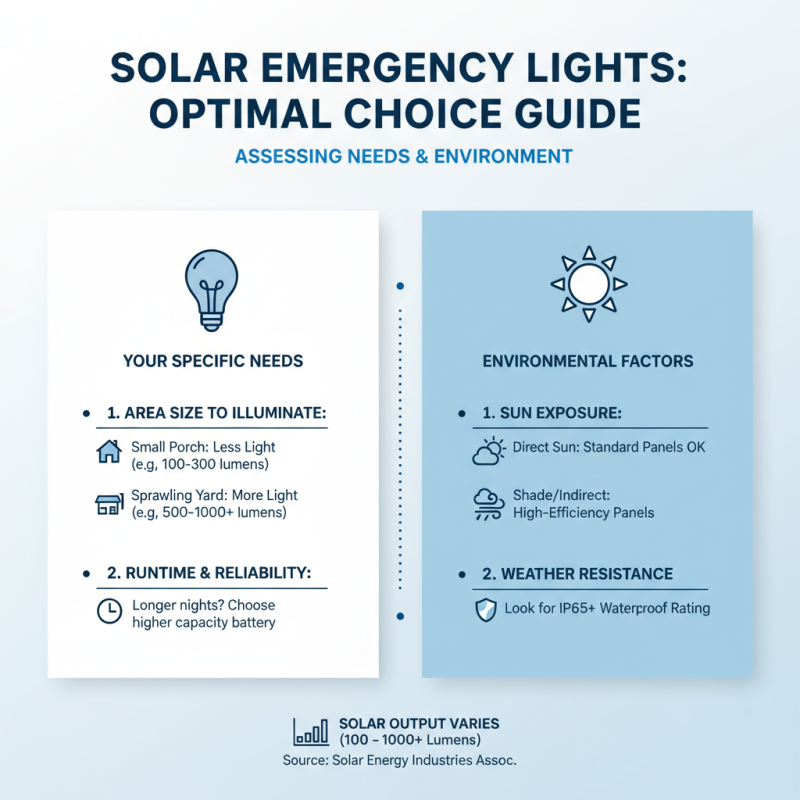
When choosing a solar emergency light, assess your specific needs and environment carefully. Start by evaluating the size of the area you need to illuminate. A small porch may require less light than a sprawling yard. According to the Solar Energy Industries Association, the average output of solar lights varies significantly, with some models offering as little as 100 lumens, while others can exceed 1,000 lumens.
Consider your typical usage as well. If you only need light during short power outages, a compact model may suffice. However, for extensive blackouts, a more powerful unit is crucial. Reports indicate that 70% of users prefer lights with adjustable brightness. This flexibility can help extend battery life for emergencies.
Environmental factors also play a key role. Homes in sunny areas will benefit from solar lights that charge quickly. However, locations with frequent cloud cover might need units with higher battery capacity. It's not uncommon for people to overlook these environmental specifics, leading to inadequate performance. Planning for seasonal changes is also important. Many lights might struggle during winter months when daylight hours are shorter.